WUCIOA Invites Co-Owners to “Take Ownership”
Taking ownership” and “taking ownership” are not the same thing. One produces drastically different outcomes than the other.
For example, two communities - one elsewhere, the other here in Washington - each faced the same existential threat: A condominium structure was at risk of eventual collapse unless massively expensive repairs were made. Would owners rise to the occasion and save their homes?
In the “taking ownership” community, the condominium eventually collapsed. In the “taking ownership” community, the condominium still stands.
Different outcomes indeed. But why does this distinction produce this difference?
Taking Ownership
You crawl before you walk. And you rent before you buy. Renting is transactional. You pay rent and the landlord takes care of the property. Paying rent entitles you to use the property, but it does not obligate you to care for it. In the eyes of the law, it is taking ownership of property that obligates someone to care for it. So, caring for the property is the landlord’s job, not yours.
Now fast forward. Taking ownership of a condominium unit makes you the property owner. It obligates you to care for your unit. You understand this.
But buying the unit also means taking co-ownership of the common elements. And, in the eyes of the law, taking co-ownership of property obligates you and your neighbors to care for the condominium.
Because group decision making is as unwieldy as herding cats, the legacy condominium statutes created an association and tasked it with caring for the condominium. You naturally take this to mean that an association is like a landlord. You pay them - the landlord or the association - and they take care of the property. To your mind, tasking an association with this job absolves you of responsibility for maintaining the condominium.
The flaw in your reasoning is that co-ownership is not transactional. It is relational, meaning that group outcomes are largely a product of how united or divided group members are.
Taking Ownership
The still-standing Washington condominium above owes its survival to the fact that its co-owners took ownership of the obligation to care for their condominium.
Owners began by acknowledging the obvious: An association is simply a means by which co-owners make and implement decisions about how best to meet their obligation - as co-owners - to care for their condominium.
Taking ownership of the challenge facing them meant that they did not waste time and money scapegoating “the association” for the decades of deferred maintenance that produced the crisis they faced.
Taking ownership of the challenge meant accepting that the only way forward was for owners to unite in common cause in shared pursuit of the seemingly impossible task of rescuing their condominium from its impending demise. A rescue which - by working together - the group miraculously achieved.
Common Sense Codified
Taking true ownership of co-ownership responsibilities was the focus of a session at last winter’s CAI National Law Seminar. Four key takeaways from that session are that:
Culture comes first;
A contribution culture - (think “rescued,” above) - produces better outcomes than a consumer culture - (think “collapsed,” above) - does;
A great place to live is the outgrowth of neighbors first “taking ownership” of the work needed to create it; and (spoiler alert)
The Washington Uniform Common Interest Ownership Act (“WUCIOA” or “the Act”) essentially codifies the common sense notion that a united group can achieve outcomes that a divided group cannot.
The Act reformulates the bargain that buying a condominium forms. It tells boards to earn owners’ trust by acting transparently, by acting in good faith, and by listening intently to owners before making a consequential decision. And it tells owners to contribute to the group’s success, to say what their board needs to hear, to give their directors the benefit of the doubt, and to respect board decisions fairly reached.
The Act’s message to boards is loud and clear. But the Act’s counterbalancing message to owners is not. Instead, it is concealed between the lines. When it comes to what it expects from owners, the Act simply cannot bring itself to say its quiet part out loud.
The unvarnished truth is that caring for a condominium is necessarily a group effort. And the Act calls upon owners to contribute to that effort.
But the Act’s between-the-lines directive that owners actually “take ownership” of their co-owner responsibilities is lost on the reader. And that’s a problem, because a call gone unheard is a call gone unheeded.
One solution to this problem? An Owners’ Overview that says the Act’s quiet part out loud.
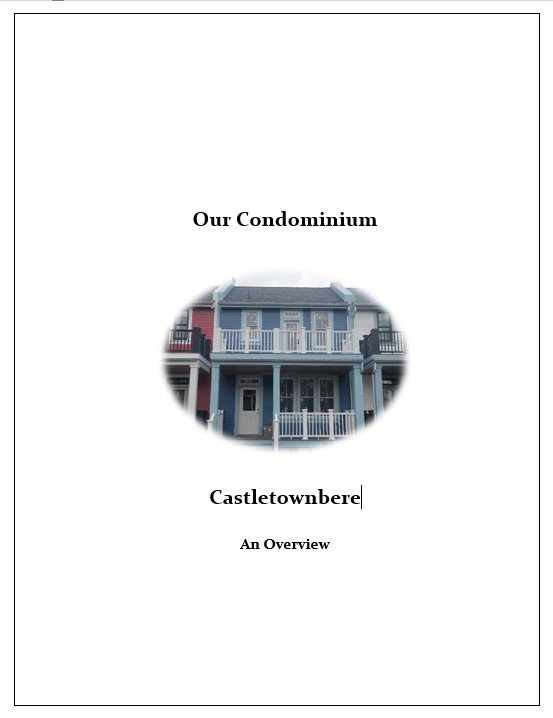
Imagine this. Upon crossing the threshold into your newly purchased home in Castletownbere Condominium, you pause to take in the empty rooms and walls, a blank slate now, but destined to be a self-portrait of sorts, once your decorating is done.
Something on the kitchen island catches your eye: A card and a booklet. The card, signed by your new neighbors, welcomes you home. And the booklet - the Overview - fills you in on what being a neighbor here really means. It unmistakably invites you to personally take ownership of the co-owners’ shared mission of creating a great place to live.
The Act’s calling laid bare, you now ponder how you might best contribute to the group’s efforts. And it is in the act of answering that question that your “taking ownership” of the group’s mission actually occurs.